Incarcerated Women: Domestic Violence, Trauma, and Incarceration
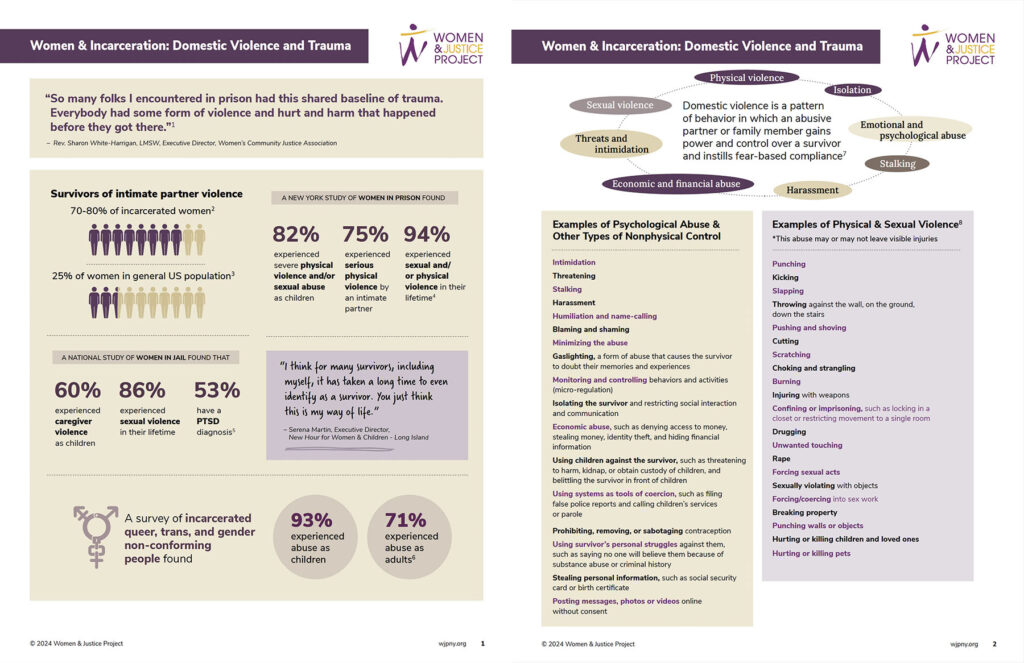
“So many folks I encountered in prison had this shared baseline of trauma. Everybody had some form of violence and hurt and harm that happened before they got there.”
– Rev. Sharon White-Harrigan, Executive Director, Women’s Community Justice Association
Download the full infographic
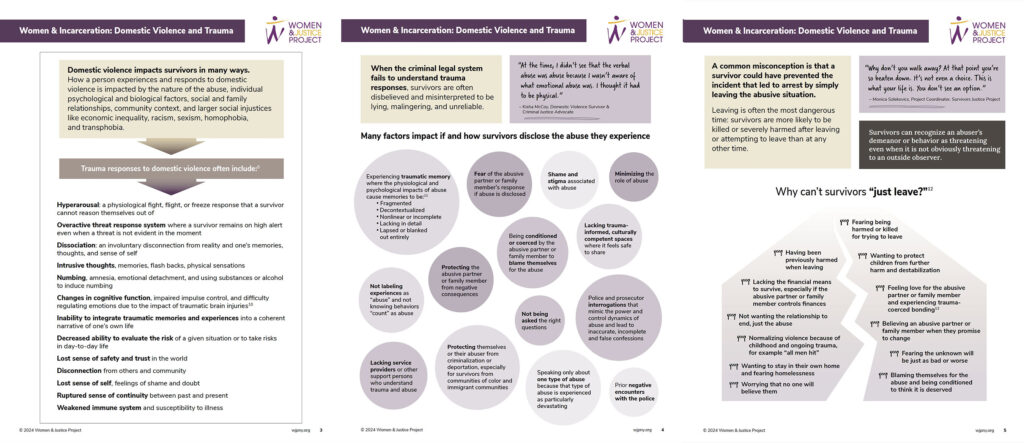
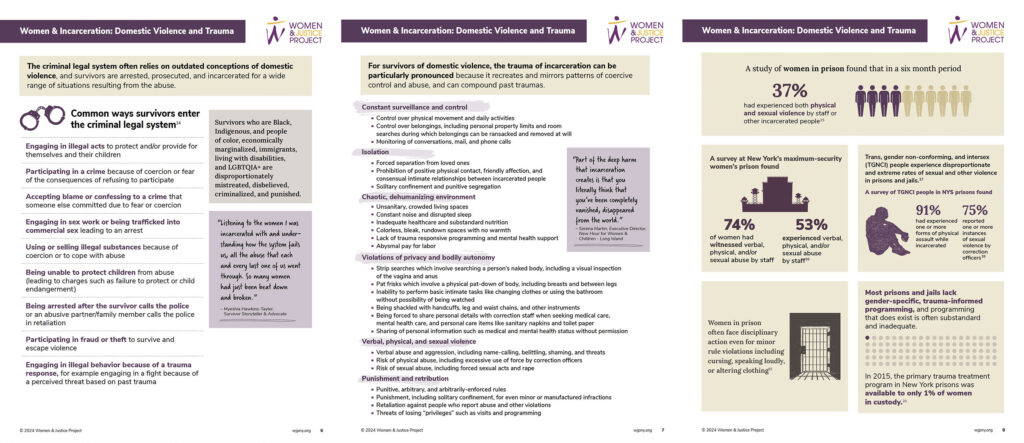
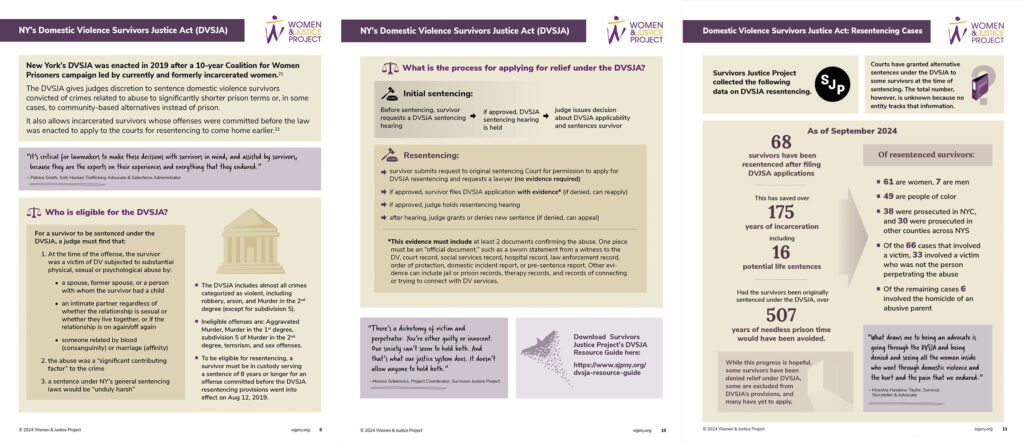
Incarcerated Women: Domestic Violence, Trauma, and Incarceration highlights the inextricable link between interpersonal violence and women’s incarceration, details how trauma and abuse form direct pathways to criminalization, and presents the progress and challenges of the Domestic Violence Survivors Justice Act (DVSJA). The DVSJA was enacted in 2019 after a 10-year Coalition for Women Prisoners campaign led by currently and formerly incarcerated women. The Act gives judges discretion to sentence domestic violence survivors convicted of crimes related to abuse to significantly shorter prison terms and, in some cases, community-based alternatives instead of incarceration. It also allows survivors currently in prison to apply to the courts for resentencing and earlier release. We hope this infographic will be useful as an educational and advocacy tool for a wide range of audiences, including survivors and other advocates, service providers, educators, and attorneys and other court actors.
“There’s a dichotomy of victim and perpetrator. You’re either guilty or innocent. Our society can’t seem to hold both. And that’s what our justice system does. It doesn’t allow anyone to hold both.”
– Monica Szlekovics, Project Coordinator, Survivors Justice Project
Our deep gratitude to the following individuals and organizations for their expert review and contributions: Kathy Boudin, Judy Clark, Michelle Daniel-Jones, Myeshia Hawkins-Taylor, Christina Holdrege, Patrice James, Melissa Mahabir, Serena Martin, Kisha McCoy, Kate Mogulescu, Alan Rosenthal, Anisah Sabur, Patrice Smith, Monica Szlekovics, Sharon White-Harrigan, Survivors Justice Project, and the Criminalized Survivors Program of STEPS to End Family Violence, a program of Rising Ground.
To view the sources on this data or download the print version of this infographic click here
Share this page